|
|||||
|
|||||
| ||||||||||
|
Hemorrhoids
The dentate line is an imaginary line that separates the two types of skin present in the anus and anal canal. Internal hemorrhoids occur above the dentate line and are generally painless. This type of hemorrhoid is characterized by bleeding and may push out of the anal opening (prolapse). External hemorrhoids occur below the dentate line and can be extremely painful, especially in severe cases. SymptomsSymptoms of hemorrhoids include:
DiagnosisDiagnosis of hemorrhoids is made after a careful examination of the anus and anal canal. This examination may be assisted by the use of an anoscope, a thin, viewing tube, which can be inserted into the anus to view the anal canal. During diagnosis, it is imperative that other more serious diseases, which can also cause bleeding from the rectum and colon, such as polyps and cancer be excluded. Bleeding from the colon or rectum are often the only signs of cancer, so this possibility must be explored before a confirmed diagnosis can be made. Procedures such as a colonoscopy or sigmoidoscopy may be used in this determination. TreatmentThe best treatment for hemorrhoids is prevention. Start by preventing constipation by following a diet which is high in bulk and fiber. Consult a dietician or your physician with these concerns. If a healthy diet is ineffective, laxatives may be used in moderation to avoid constipation. There are many types of creams and suppositories, which can relieve minor pain and irritation. A Sitz bath (sitting in a bath of warm water) may also relieve irritation. Stool softeners may be prescribed to make passing stools easier. If diagnosis is immediate, severe hemorrhoids can be surgically removed; otherwise, they will dissolve, break and bleed out on their own in about a week. Bleeding hemorrhoids are often internal. There are several methods to treat this type of hemorrhoid. If the condition is mild:
Under severe conditions, surgery may be necessary in order to remove the hemorrhoid (hemorrhoidectomy). This procedure may be performed with a scalpel, cauterizing device or laser. The use of a laser is thought to be the most painless. In any case, the individual should heal within 2-4 weeks and be able to return to work within a week. |
|
BrooklynGI.com with offices in New York City
Brooklyn Queens and Manhattan. Treating patients from New York, New Jersey and
Connecticut. is dedicated to helping patients and physicians receive accurate
and up-to-date information on the Gastrointestinal tract (GI Tract) The organs
that compose the GI tract include, Esophagus, Stomach, Small Intestine, Large
Intestine (Colon), Pancreas and the Liver and Gall Bladder (Hepato-Biliary Tree)
Dr. Scott Tenner Contact
DrTenner@BrooklynGI.com
with questions or comments.
|





















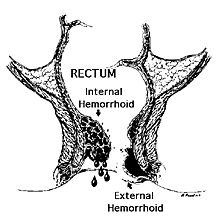 Hemorrhoids,
also known as "piles" are caused by an enlargement or dilation of veins
surrounding the anus. This enlargement is most commonly due to constipation
which can be caused by a poor diet, low in bulks, fiber and grains.
Hemorrhoids may also result from straining to excrete stool, aging, pregnancy,
diarrhea or anal intercourse. There are two types of hemorrhoids: internal and
external.
Hemorrhoids,
also known as "piles" are caused by an enlargement or dilation of veins
surrounding the anus. This enlargement is most commonly due to constipation
which can be caused by a poor diet, low in bulks, fiber and grains.
Hemorrhoids may also result from straining to excrete stool, aging, pregnancy,
diarrhea or anal intercourse. There are two types of hemorrhoids: internal and
external. 














